Notes and writing
What end-to-end encryption protects in a note app
Understand transport encryption, encryption at rest, key ownership, and recovery before choosing where to keep private notes.
On this page
“Encrypted” can describe several different protections. To understand who can read your notes, ask where encryption happens and who can obtain the keys needed to decrypt them.
Separate the layers
Transport encryption protects communication between endpoints, such as your device and a service. Encryption at rest protects stored data, but the provider may manage the keys. End-to-end encryption aims to keep content readable only at the intended endpoints, rather than by the service relaying or storing it.
These protections can coexist. A service using TLS is not necessarily storing plain text, and a service encrypting its disks is not necessarily end-to-end encrypted.
Check the actual coverage
Look for documentation identifying which content is protected and which metadata remains accessible. Titles, attachments, shared notes, and backups may have different rules. A confirmation code during device setup does not, by itself, prove that the implementation is end-to-end encrypted.
Understand recovery before you need it
Account recovery and recovering encryption keys are related but distinct. Some systems use trusted devices, recovery contacts, or recovery keys. Apple documents such recovery mechanisms for end-to-end encrypted iCloud data. Recovery being possible does not automatically mean the provider can read the content.
If all usable keys and recovery methods are lost, an encrypted copy alone may be insufficient. Set up the recovery options supported by your service and understand where they are stored.
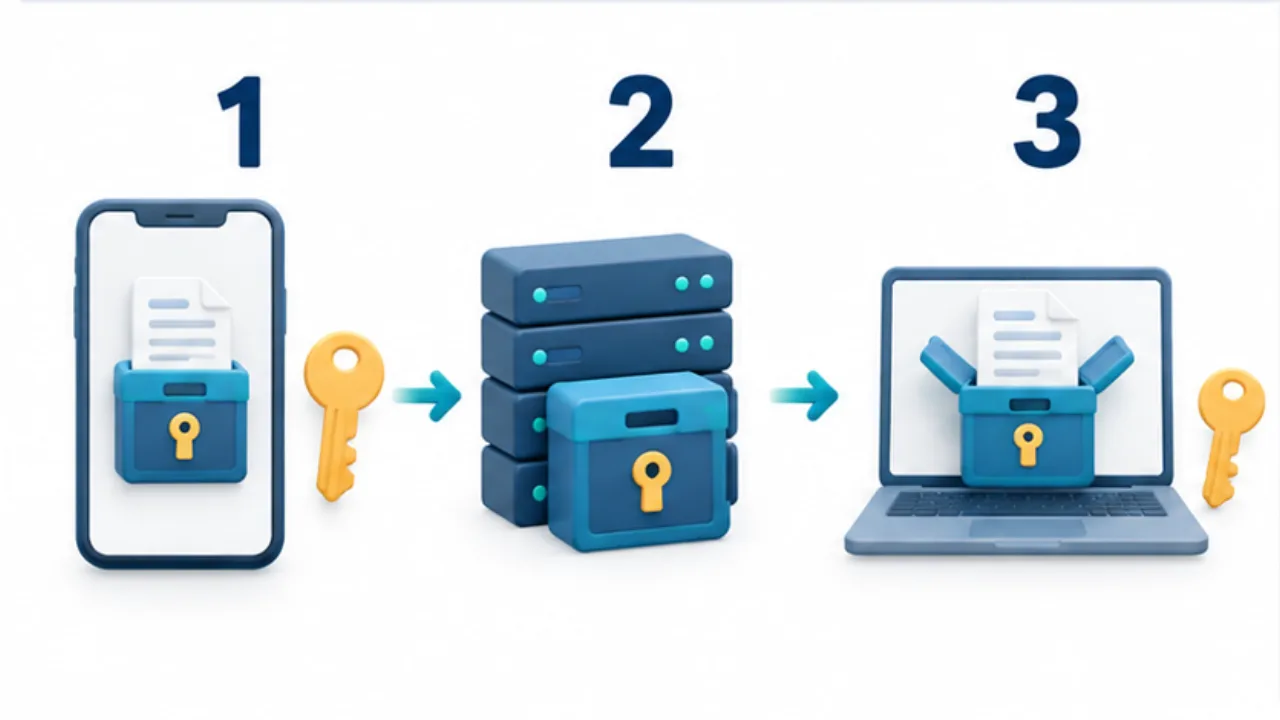
Select the image to enlarge.
- Encrypt the content on the sending device.
- Store ciphertext on the intermediary server without giving it the decryption key.
- Use the necessary key to read the content on the receiving endpoint.
Consider the endpoints and exports
Encryption does not make an unlocked device immune to someone reading its screen or using an authorized app. An exported note may also be plain text. Protect the device and backup location as part of the same plan.
For the difference between a second copy and a recoverable earlier state, see note backups.
Distinguish signing in from reading old content
Imagine signing in successfully on a new device but being unable to open an earlier note. Authentication establishes that you may use the account. Decryption requires the material needed to read the encrypted content. How those processes connect depends on the service, so passing a login screen does not prove that recovery is complete.
| Situation | Question to answer |
|---|---|
| Signing in on a new device | Is approval or separate recovery information required? |
| Resetting a forgotten password | How does account recovery connect to old encryption keys? |
| Losing every registered device | Which recovery route remains available? |
| Opening text but not an attachment | Does the attachment need another download or key step? |
You can examine the ordinary device-transfer process with a test note that contains no sensitive information. Open both its text and attachment in the new environment and compare the result with the documented procedure before deciding what to do with the old device.
Do not deliberately remove every recovery option to test an account. Understanding the documented route and verifying a safe transfer gives useful evidence without creating a real lockout.
Follow the content through sharing and export
If you copy an encrypted note into a shared document, the copy is governed by the destination's access and storage arrangements. The source application's protection does not automatically follow text pasted elsewhere.
For a fictional meeting record, sketch the route through writing, synchronization, sharing, and backup. You do not need a detailed cryptographic diagram. An operational note such as “Share only the agreed section” or “Keep recovery information outside this notebook” can make the relevant boundary clear.
When product documentation is ambiguous, ask specific questions: Does coverage include attachments? Does public sharing change the protection? Can the provider alone obtain the keys needed to decrypt this content? These questions are more informative than relying on an algorithm name or the presence of a recovery button.