Notes and writing
A small morning journaling routine

Write down what is on your mind, distinguish concerns from actions, and choose a useful starting point for the day.
On this page
A morning note can be a place to orient yourself before opening messages. The routine here is an editorial suggestion: write briefly, then choose what needs attention. It is not a tested treatment or a promise of improved concentration.
Start with what is present
Write about the work, question, or concern currently occupying your attention. A few unfinished sentences are enough to begin. You do not need a record of yesterday, a gratitude list, and a plan for the entire week on the same page.
If a time limit helps you start, choose one that fits your morning. It is a practical boundary, not a required dose.
Separate concern from action
Review what you wrote and identify anything you can actually do. “I am behind on the proposal” is a concern. “List the missing figures and ask for them” is a possible next step. Some concerns may have no immediate action, and writing them down does not require you to resolve them that morning.
Keep the routine distinct from other methods
Julia Cameron's Morning Pages have their own instructions, including handwritten pages. Expressive-writing studies use different protocols and outcomes. This short morning routine borrows the idea of writing freely, but should not inherit claims made for those other practices.
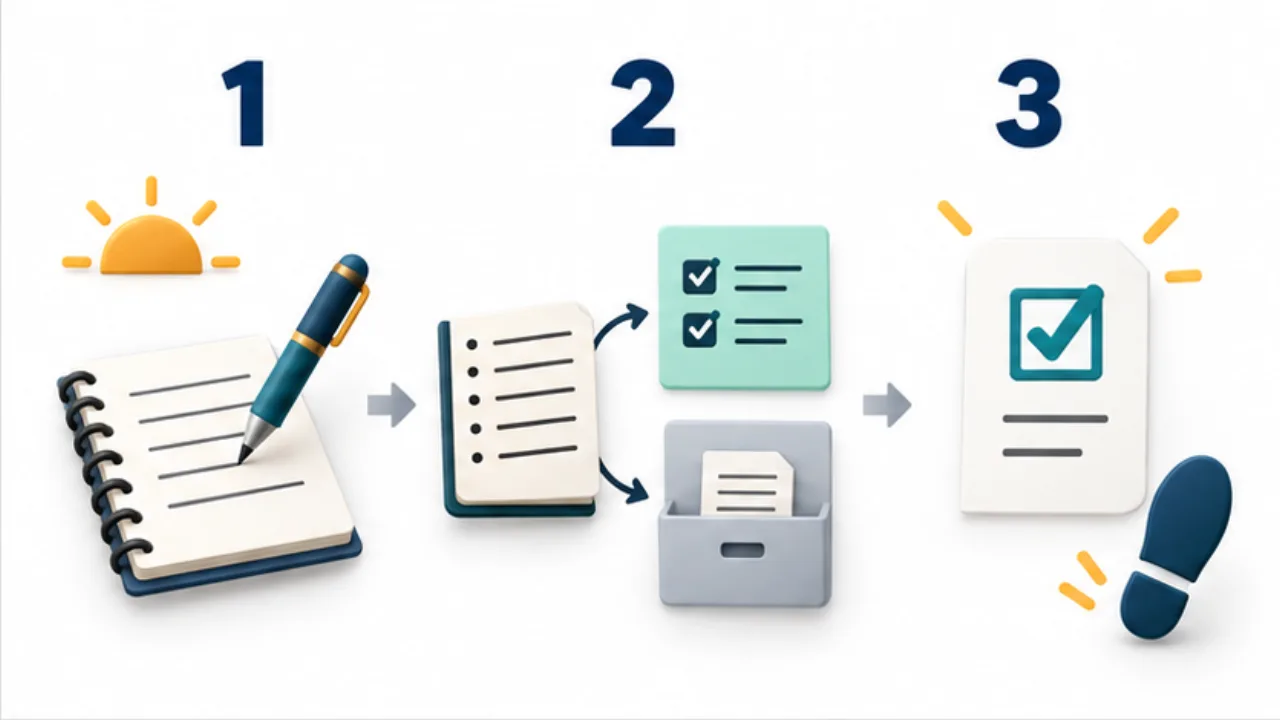
Select the image to enlarge.
- Write what is occupying your attention without polishing it.
- Distinguish what to address today from what cannot be changed immediately.
- Choose one small action you can take today.
Adjust rather than enforce
If the note becomes an obligation, reduce the template or use it only when it helps. If writing about a topic makes you feel worse, you can choose another topic or stop. Move actual appointments and deadlines into a reminder system; the journal remains supporting context.
For a reusable home for this material, see daily notes.
Follow one concern into a useful next step
Imagine writing “The proposal worries me,” “I am waiting for a reply,” and “I must not be late for the meeting.” These thoughts need different responses. Rather than treating them as one large problem, distinguish what you can do from what depends on another person or a scheduled event.
| Thought | Clarifying question | Possible next line |
|---|---|---|
| The proposal worries me | Which part is unfinished? | Check what is missing from the comparison |
| I am waiting for a reply | Was a response date agreed? | Put that follow-up date in the task system |
| I must not be late | When does preparation need to start? | Set a preparation reminder in the calendar |
Choosing a focus for the day does not cancel other commitments. Keep deadlines and appointments in the systems that manage them. The journal can preserve why something was on your mind while the reminder system handles when you need to act.
You may finish without a conclusion. “I still cannot explain what worries me about the proposal” can be the last line. Every feeling does not need to become a task.
Adapt when the morning does not go as planned
If your usual time disappears, you do not need to complete yesterday's entry first. Start from today's situation: “There is a lot of travel today; first check the meeting location.” Filling every missed page can turn a small orientation routine into an accumulating assignment.
When the question feels too heavy, change the question as well as the duration. Instead of exploring a concern, you could note the first document to open or the things to bring. You can also skip writing when it is not useful.
Judge the routine by whether it helps you clarify the start of your day and whether writing itself remains manageable. Consecutive-day counts do not establish either outcome. Moving the routine to another suitable time before work can preserve its practical purpose without forcing an idealized morning schedule.