Notes and writing
A daily note without a complicated filing system

Use one dated page to capture your day, carry useful tasks forward, and find earlier notes without reorganizing your archive.
On this page
Choosing a folder can interrupt a thought before you have written it down. A daily note gives new material a default home: today's page. The aim is to make capture easy while preserving enough context to find things again.
Start with a date
Create a page named with a consistent date, such as 2026-09-08. Add notes in the order they happen. A meeting, a question, and a draft can share a page; use headings or blank lines to separate them. Apps with a daily-note feature can create the page for you. A normal text file also works.
Do not move your entire archive before starting. Leave earlier notes where they are and use the new arrangement for incoming material.
Give each entry a useful clue
“Ask about the estimate” may make sense today and become mysterious next month. “Ask Acme about the warehouse estimate” carries searchable names and a subject. For a long meeting record, keep a short entry on the daily page and link to a separate note.
- Decision: Acme will review the revised warehouse plan.
- Action: Send the drawing before Thursday's call.
- Question: Does the estimate include installation?
These labels are an example, not a required notation.
Carry forward deliberately
When opening tomorrow's page, review unfinished actions. Copy the ones that still matter, complete or cancel others, and put time-sensitive commitments in a task manager or calendar. Repeatedly postponing a task is a reason to investigate a blocker, not proof that the task is unnecessary.
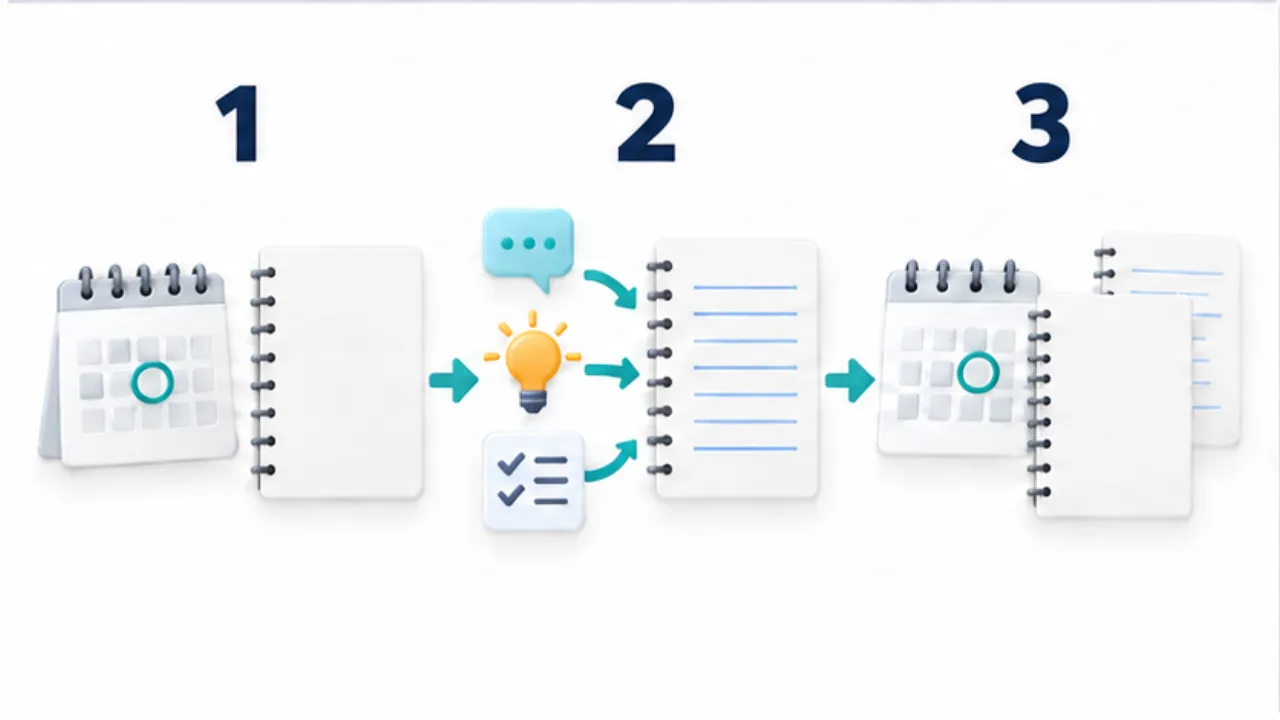
Select the image to enlarge.
- Open a page labeled with today’s date.
- Capture that day’s records and ideas on the same page.
- Start a new dated page tomorrow and retain the previous one.
Find and develop earlier work
Search for the project or person, then narrow by date if needed. Promote material into a separate project note when it needs a stable home. Avoid polishing every daily page just to make the archive consistent. The useful test is whether you can recover a decision and its context.
For the search side of this approach, see writing searchable notes.
Distinguish the recording date from the event date
If you add yesterday's meeting to today's page, the page name alone does not describe when the meeting happened. Include a short note identifying the event date and that you are recording it later.
For work spanning midnight, choose a consistent page boundary suited to your process. External deadlines and appointments still need their actual dates and times. A personal logging convention should not replace a shared commitment's timing.
Example: resume a draft from yesterday
Imagine preparing a shop notice. Today's entry can say that the earlier draft was reviewed and the reception hours still await confirmation. Add a route to yesterday's record.
When the answer arrives, append the result and the location of the current approved version. This preserves continuity without rewriting every earlier entry.
| Field | Example |
|---|---|
| Earlier record | Dated note about the notice draft |
| New information | Product name confirmed |
| Unresolved | Reception hours awaiting the responsible person's reply |
| Next action | Update the delivery PDF after confirmation |
| Current source | Location of the approved draft |
When turning a daily fragment into shared material, extract only the appropriate content. There is no need to share an entire day containing personal thoughts or unrelated project information.
If carried-forward actions accumulate, consider managing their status in a task system and linking from the daily page instead of copying all of them every morning.
Chronology and execution status can have separate homes. The practical check is whether you can resume the necessary work without searching through old dates for an action that still matters.
A daily-note convention should support that continuity. Adjust the handoff when the routine becomes burdensome rather than treating a fixed copying rule as the purpose of the method.