Notes and writing
Expressive writing, with realistic expectations

Understand what expressive-writing research studies, how a personal writing exercise differs, and why you can stop when it does not help.
On this page
Expressive writing involves writing about thoughts and feelings around a personal experience. It has been studied in psychology, but its effects are not uniform. A short journaling exercise should not be presented as a guaranteed way to stop worry or treat a condition.
Distinguish the research from a personal routine
Research protocols specify instructions, session lengths, participants, and outcomes. Changing these produces a different activity. A brief writing break may be convenient, but convenience does not establish that it has the effects found in a particular study.
Rude and colleagues discuss inconsistent findings in the expressive-writing literature. Their work is a reason to be precise about conditions rather than promise the same result to every reader.
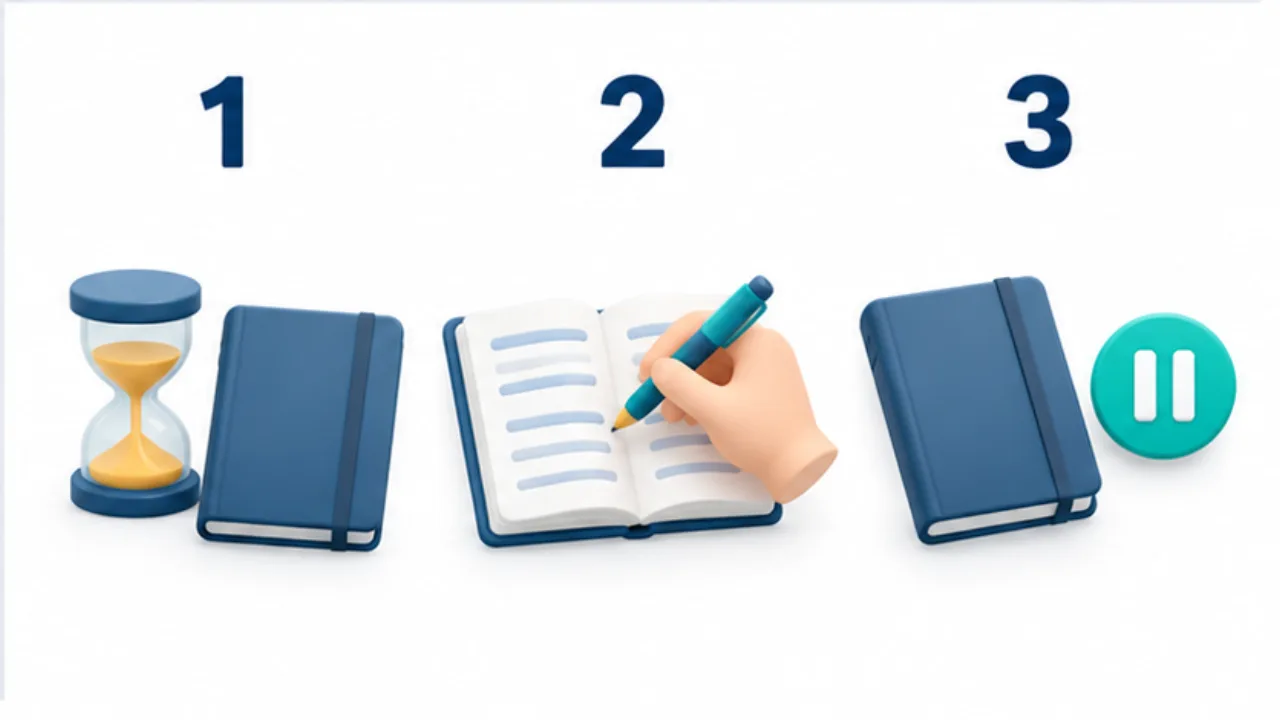
Select the image to enlarge.
- Choose a brief period that feels manageable.
- Write what you feel comfortable addressing without polishing the form.
- Stop if it becomes distressing and choose how to keep or dispose of the writing.
Choose what you are willing to write
For a personal reflection, select a manageable topic and a private place. You can write an observation, a feeling, and a question without producing a polished narrative. You do not have to choose the most painful event or share the result.
An example might be: “The review was postponed. I feel uncertain about the schedule. I need to ask when the next decision will happen.” This is a writing prompt, not a clinical protocol.
Notice your response
Writing does not always make someone feel calmer immediately. Do not treat distress as proof that the exercise is working or that you must continue. You can pause, change the topic, or stop. Persistent or severe difficulties deserve appropriate support rather than a promise that another page will solve them.
Decide what to keep
Afterward, choose whether the note needs saving, a practical follow-up, or no further action. Keep private material somewhere whose sharing and backup behavior you understand. The value of a reflection need not depend on rereading it repeatedly.
Separate an event, a feeling, and an interpretation
The following fictional example is an everyday note, not a treatment protocol. Suppose you begin with “The meeting was postponed, and it feels as though my plan does not matter.” You can separate what is known from how you experienced it.
| Part | Fictional entry | Distinction |
|---|---|---|
| Event | A postponement message arrived | Something you can verify |
| Feeling | I feel disappointed after preparing | Your experience |
| Interpretation | Perhaps my plan is not important | A conclusion not yet established |
| Open question | Why was it postponed, and when will it happen? | Information you might clarify |
This separation does not guarantee that the feeling will change. Nor is it a way to grade the feeling as correct or incorrect. You can be disappointed without replacing that feeling with a positive sentence.
If clarification is useful, move “Ask about the next meeting date” into a practical note. Do not automatically send the private writing to the other person. A reflection and a message used to coordinate work serve different purposes.
You can finish without finding a lesson
Requirements such as “End with a lesson” or “Choose an action every time” can become another burden. An unanswered question may remain unanswered when you close the page. You may avoid a topic or stop before a planned time ends. Distress is not evidence that the exercise is working.
If saving the writing, choose whether and where you want to encounter it again. Consider screen sharing, search results, and shared notebooks when storing private material. If you prefer not to retain it, separate any practical commitments you need without requiring yourself to reread difficult passages.
Neither word count nor consecutive days determines whether the routine suits you. Feeling somewhat clearer, feeling worse, or noticing no change are all observations. If the activity adds distress, do not make continuing the assignment. Stopping, changing the topic, or seeking appropriate support are valid next choices.