Notes and writing
When a note app does not become a habit

Find the point where capture or retrieval breaks down before replacing the app or redesigning every folder.
On this page
An abandoned notebook does not automatically mean you need more discipline or a better app. It may mean the current process asks for decisions at the wrong moment. Look at a recent occasion when you wanted to write something and did not.
Locate the interruption
Was the app difficult to open? Did you stop to choose a notebook or title? Did you write the note but fail to find it later? These are different problems and should not receive the same solution.
Try capturing a real thought from your normal starting point. Observe the steps that slow you down. There is no universal number of seconds after which an idea disappears.
Simplify the entry point
Put new material in a predictable place, such as an inbox or today's note. Use a shortcut or widget if your device and app support one. Add a descriptive clue, but postpone classification that is not needed at capture time.
Respect separate storage requirements for work and personal information. Reducing friction should not erase those boundaries.
Check whether retrieval is the real problem
Search for a note you know exists. If the app cannot find it, check the words used, search scope, and attachment support. Better retrieval clues may help more than another hierarchy of folders.
Change one thing at a time
Try the simpler entry point on new notes before migrating your archive. Evaluate whether it helps you capture and recover useful material. If a required feature is missing, then investigate another app and rehearse the migration. A method that suits one person's work need not suit everyone.
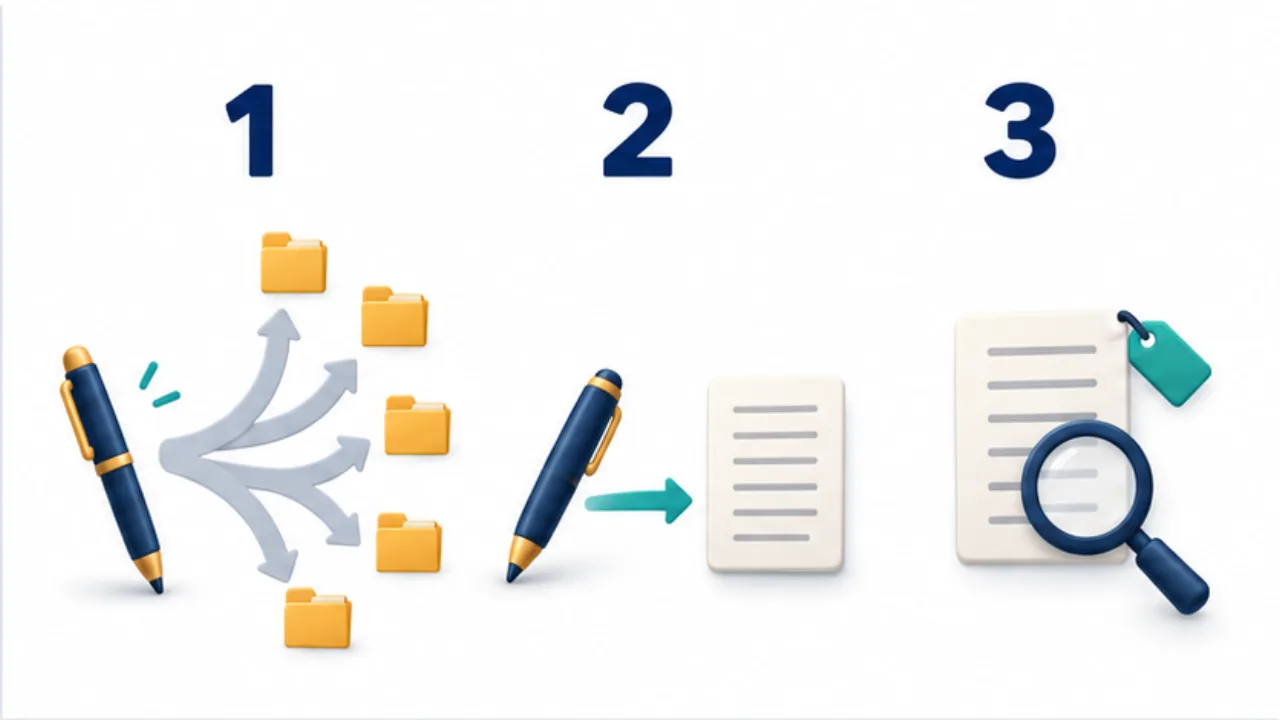
Select the image to enlarge.
- Reduce choices that interrupt writing.
- Capture a short note in the chosen place first.
- Test retrieval later and add only organization that proves useful.
Example: test the interruption you actually observed
Imagine someone trying to keep meeting notes who stops when choosing a project folder. Before replacing the application, they could try putting meeting captures into a predetermined inbox.
That experiment addresses hesitation before writing. It would not necessarily solve a different person's problem of already capturing notes but failing to retrieve them. That person should inspect search terms and review practices instead.
Write one success condition before experimenting: capture the necessary information without interrupting the conversation, or retrieve the note later by project name. Choose a period long enough to encounter the relevant work. A suggested two-week trial is an editorial starting point, not a threshold that guarantees a habit.
Decide what to keep from the observed result
| Observation | Next adjustment |
|---|---|
| Capture and retrieval both work | Keep the entry point without adding classification |
| Capture works but projects are hard to distinguish | Add a project name or short heading |
| Deadlines remain buried | Add a deliberate task-extraction review |
| Work and personal material have different audiences | Preserve separate storage boundaries while simplifying entry |
| A necessary function is unavailable | Evaluate tools against that specific requirement |
An inbox that does not fit your work is also an informative result. There is no need to force different sharing boundaries or time-specific commitments into one undifferentiated store.
A practical sequence is to make capture predictable, then route material according to responsibility and timing. Record the situations that caused difficulty, not only the number of days on which you wrote.
An irregular writing pattern is not automatically a failed system if it serves the occasions when you need it. Tie each retained rule to an observed problem. This keeps the next improvement concrete and prevents the trial from becoming another elaborate organization project before you know what is missing.