Notes and writing
Use writing to examine a thought

Separate observations, interpretations, and open questions so a vague concern becomes easier to inspect.
On this page
A thought can feel settled until you try to state it precisely. Writing gives you something to inspect, revise, and compare with evidence. The simple structure here is a practical exercise, not a claim that writing always makes thinking clearer.
Start with the observation
Write what you directly know: a message, an event, a number, or an action. Keep it separate from what you believe it means. “The client has not replied since Monday” is an observation. “The client has rejected the proposal” is an interpretation unless you have confirmation.
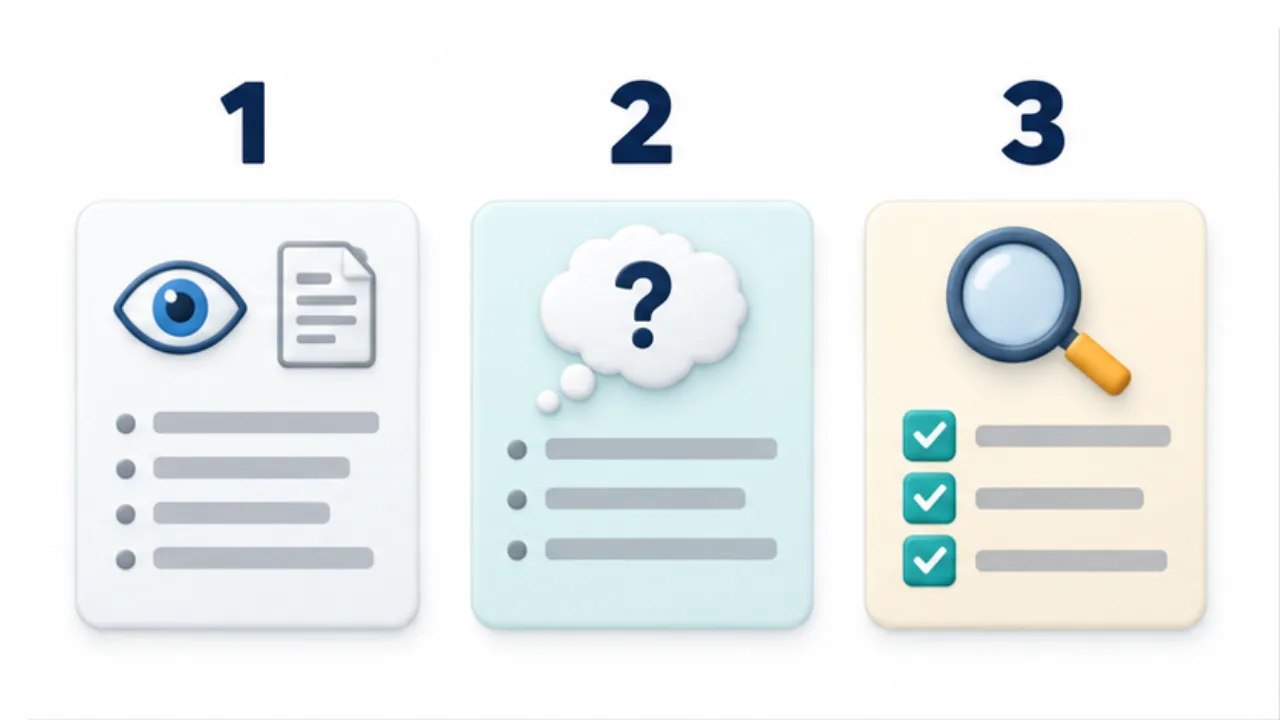
Select the image to enlarge.
- Record observations and received statements as facts.
- Keep possible explanations in a separate interpretation field.
- Decide what to check before reaching a conclusion.
Name the interpretation
Record your current explanation and possible alternatives. This does not require pretending all explanations are equally plausible. It makes the inference visible so you can ask what supports it.
For the unanswered message, alternatives might include a delayed review, absence, or a missed notification. The next useful step may be a status check rather than rewriting the entire proposal.
Write the unresolved question
Ask what information would change your decision. Avoid a question so broad that it has no observable answer. “Who is reviewing the proposal, and when is their decision expected?” provides a more useful next step than “Why is this going badly?”
Leave a retrievable record
Add the topic and date. When new information arrives, update the conclusion while preserving the reason for the change if it matters. Searchable terms help you reconnect the note to later work.
The three-part structure can be used inside a daily note. It need not become a separate system or a template you must complete for every thought.
Update the conclusion when information arrives
A note separating observation and interpretation need not be complete when first written. When a reply or document arrives, record which explanation it supports and which needs reconsideration.
If the initial guess was wrong, preserve a short reason for the changed judgment rather than silently replacing it. For a hypothetical example, a client explains that another department is reviewing the proposal. Record that as information received from the client, and stop treating assumed dissatisfaction as established.
The next action may shift from revising everything to checking whether additional material is needed.
Select information that affects the decision
| Unknown | Relationship to the decision | Next treatment |
|---|---|---|
| Submission deadline | Determines work order | Confirm with the responsible person |
| Selected proposal option | Determines what to prepare | Ask whether selection is complete |
| Another person's private thoughts | Not directly established | Retain explicitly as an interpretation |
| Unrelated detail | Does not affect this decision | Leave pending until needed |
You do not necessarily need every question answered before taking any action. Identify information that would change the current choice and connect it to a feasible check.
Where several explanations remain possible, consider one question that would distinguish them. That can be more actionable than repeatedly restating which explanation feels most plausible.
Finish with separate lines for what to check and what to decide from the result. Where relevant, define what can proceed if the information remains unavailable.
The note's purpose is continuity of judgment. It should let you return later, see what was known at the time, and understand why the next action was chosen. It does not need to become a polished essay to serve that role.
References
- Obsidian: Search — Documentation for retrieval; the writing exercise above is an editorial proposal, not a psychological effect established by this source.