Notes and writing
Give saved ideas a chance to become useful

Record the context behind an idea and choose a review routine that connects it to current work.
On this page
An idea saved without context can become a sentence you no longer understand. Keeping more ideas is not the same as making them useful. This approach focuses on what to capture and how to encounter relevant material again.
Record the problem behind the idea
Alongside the thought, write what prompted it and where it might apply. “Use a checklist” is vague. “For the monthly supplier review, use a checklist so unresolved delivery questions are not skipped” preserves the purpose.
You do not need to prove the idea is good before saving it. Mark assumptions and questions rather than presenting them as established facts.
Review with a current question
When beginning a project, search your notes for its topic, audience, or constraint. This gives old material a reason to reappear. A separate scheduled review can help, but its frequency should fit your volume of notes and available attention.
Turn only selected ideas into actions
During review, choose whether to keep the idea as reference, connect it to another note, test one part, or discard it. Avoid converting every possibility into a task. An experiment needs an observable question, such as whether a proposed form captures the information currently missing.
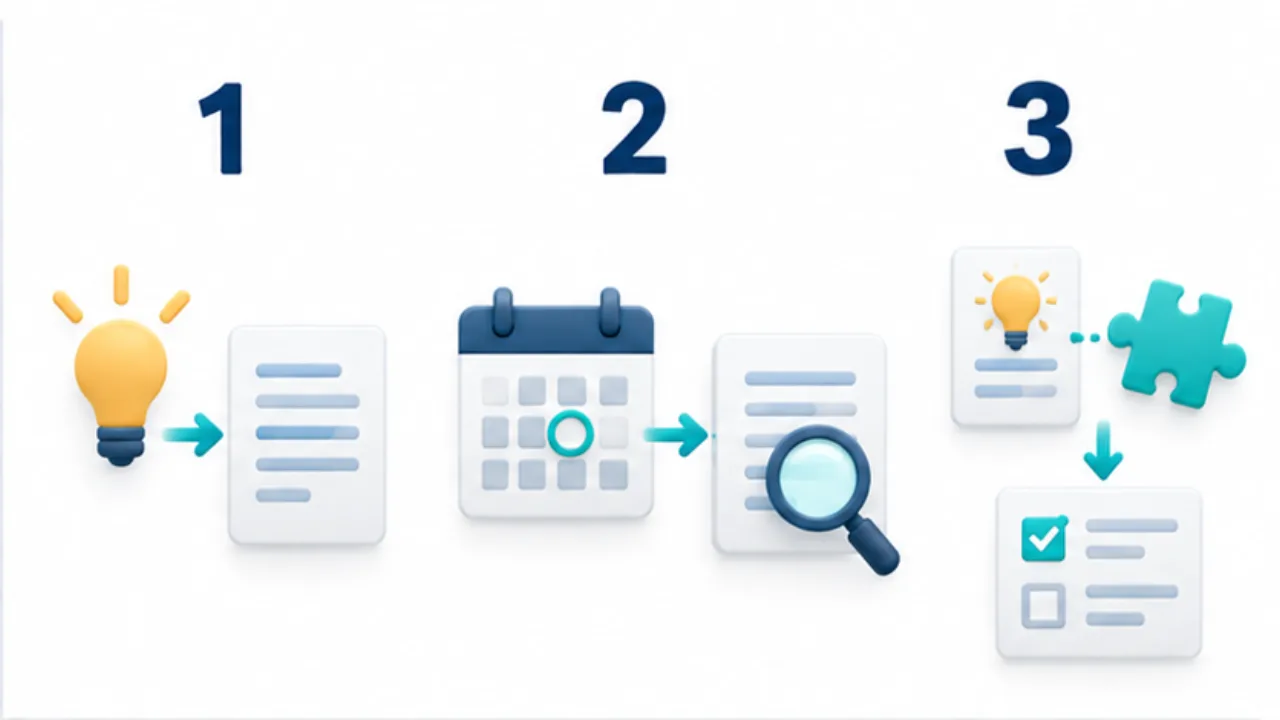
Select the image to enlarge.
- Capture enough context to understand the idea later.
- Schedule time to reopen older notes.
- Choose a small trial for an idea that fits a current problem.
Keep a small trail of development
If an idea changes, add the new reasoning and date rather than silently replacing its origin. Link related notes when the connection matters. A collection can become valuable through these specific relationships without requiring a complex tagging scheme.
For a low-friction place to capture ideas, try an inbox or a daily note.
Turn an attractive idea into a question you can examine
Consider a fictional idea to shorten an inquiry form. “Shorter is easier” does not tell you which fields to remove. If the original observation was that people keep asking what a field means, unclear wording may be a different explanation for the difficulty.
Write the proposed solution and the observed problem on separate lines.
| Part | Fictional example |
|---|---|
| Observation | People ask what “project classification” means |
| First idea | Remove some fields |
| Alternative explanation | The labels may be confusing |
| Small check | Show a sample with simpler labels and ask what each field requests |
| Decision question | Can the necessary information be entered without extra explanation? |
This is not a scorecard designed to prove that the idea should be implemented. It identifies what you need to learn before investing in it. If the result differs from your expectation, record which assumption changed rather than reducing the outcome to “good idea” or “bad idea.”
A small check is useful only when it addresses the uncertainty. Building a polished form would not, by itself, explain whether wording caused the original problem.
Give a deferred idea a return condition
You do not have to reread every inactive idea every week. If you know why it is on hold, add a condition such as “when the project starts” or “after the missing material arrives.” Use a reminder for a date-based condition and a link from the relevant project for a situation-based condition.
For the form example, there may be no realistic users to ask until the next intake period. A note saying “Show a sample to the people handling the next intake” connects the idea to a useful moment. Decide the scope of any external request or public change separately.
If each review produces only another “looks promising,” check whether you lack new observations or have posed too broad a question. Ending an investigation, linking the idea to a different problem, or retaining it with a clear reason for deferral are also useful outcomes.