Notes and writing
Borrow what you need from a note-taking method

Compare the jobs done by structured note systems, then adopt only the parts that solve a problem in your own work.
On this page
A named note-taking method usually addresses a particular problem. Difficulties arise when its entire structure becomes a requirement before you have identified that problem in your own work.
Ask what the method is for
The Cornell system separates note capture, cues, and a summary to support studying and review. Bullet Journal includes rapid logging and migration to reconsider unfinished tasks. These are different purposes, not interchangeable decorations for a page.
Before adopting a method, finish this sentence: “I need help with…” Examples include remembering a lecture, deciding which tasks still matter, or connecting ideas across several sources.
Try a useful component
If reviewing is the problem, try adding questions to a study note. If stale tasks accumulate, try a deliberate migration review. You do not have to reproduce every symbol or page layout to test whether a component helps.
Be clear when you have adapted a method. Your variation may be useful without being equivalent to the original instructions or their evidence.
Notice the maintenance cost
Track what you must do after capturing a note. If every short thought requires several tags, links, and a rewritten summary, decide whether those steps produce something you actually use. Remove steps that exist only to keep the system looking complete.
Keep an exit route
Preserve content in a format you can export and understand without the method's full structure. A simple daily note or inbox can remain the entry point while selected material receives more attention.
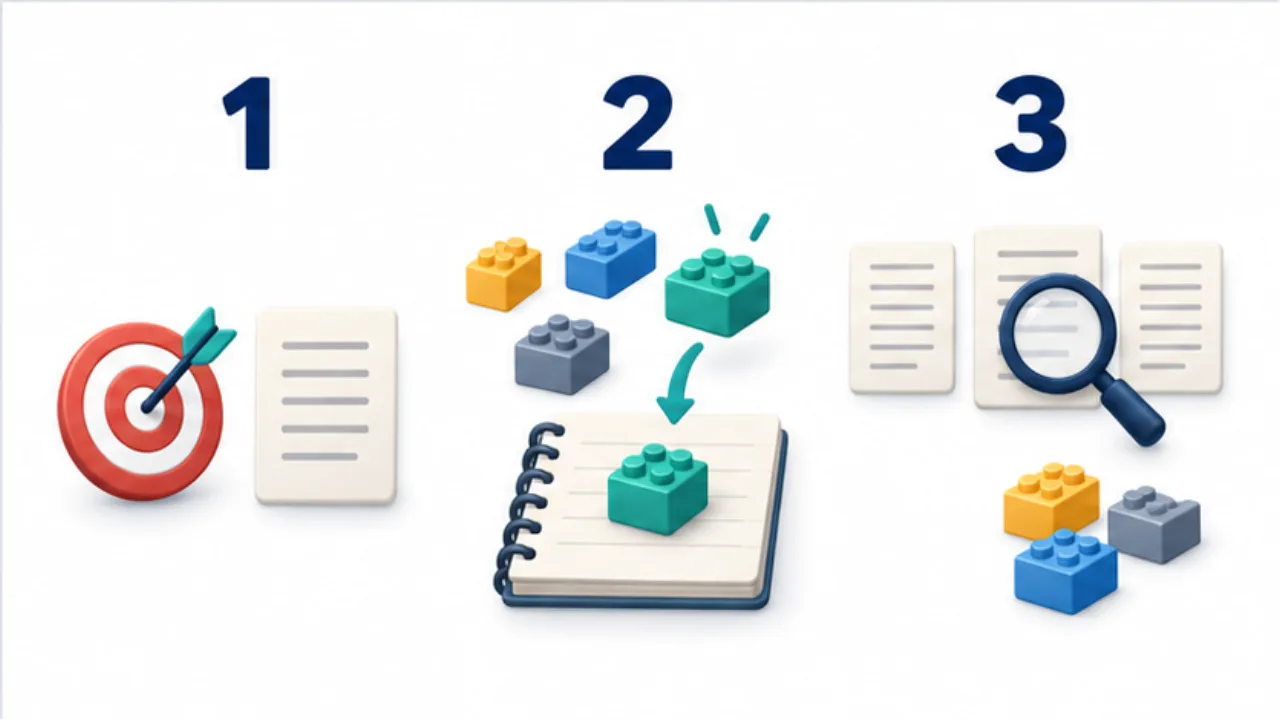
Select the image to enlarge.
- Decide what to record and how it will be used.
- Select the parts of a method that support that purpose.
- Try a small set of notes and review effort and retrieval.
Compare the problem before and after a small change
PARA distinguishes projects, ongoing areas of responsibility, resources, and archives. Luhmann's Zettelkasten supported research and writing through an extensive collection of notes and references. Those structures serve different purposes. Borrowing an active-project view or writing an idea in your own words does not reproduce either complete system.
For a fictional problem such as repeatedly opening completed-project files, try making current projects easier to reach. Record whether the next relevant task became easier, while checking that older material remains retrievable.
| Problem | Small change | What to inspect |
|---|---|---|
| Quotations are hard to explain | Add an explanation and check it against the source | Did you preserve the conditions? |
| Completed work obscures active work | Create an active-project entry point | Can you still find historical material? |
| A task keeps moving forward | Add why it is blocked | Is it unnecessary, dependent on someone, or too large? |
| Links are maintained but unused | Link material needed for the current piece of writing | Does the relationship help the output? |
A trial period is a planning aid, not a scientific threshold. If the relevant situation never occurs during that period, you have little evidence about the change. If the change immediately creates missed work, revise it without waiting for an arbitrary end date.
Decide where overlapping information is maintained
Methods can conflict when they maintain the same information in several places. If a daily journal and a team task list describe the same action, decide where completion and deadline changes are recorded. The personal note can link to that record instead of becoming another competing task list.
Describe your adaptation accurately. “Inspired by PARA” can mean something useful without implying that a two-folder variation is the full method. Distinguishing the borrowed principle from your changes helps you diagnose what worked.
When stopping a method, preserve the content and its source references. Simplify new capture first. You do not have to reorganize every existing note before trying a clearer way to handle the next one.